

Concrete driveways crack due to natural shrinkage, poor subgrade compaction, heavy vehicle loads, water pooling, and temperature shifts. Proper installation prevents cracking by building a compacted aggregate base, placing control joints to guide stress, setting a rebar grid, pouring the right mix, and following strict curing schedules.
A concrete driveway is a major investment in your property’s curb appeal, structural function, and overall market value. However, watching unsightly cracks spread across a relatively new slab is frustrating. Many property owners assume that all concrete eventually cracks, but major structural failures stem directly from rushed site preparation and skipped installation steps.
While concrete naturally contracts as it cures, deep cracks and surface spalling are completely preventable. Preventing these issues requires a disciplined installation strategy that handles weight distribution, soil movement, and climate expansion.
Here is a clear look at why concrete driveways crack, how professional installation techniques prevent structural damage, and what goes into pouring a slab that stands the test of time.
Why Concrete Driveways Crack: Causes vs. Preventive Solutions
Understanding what happens beneath a concrete slab explains why surface-level fixes never last. Concrete is exceptionally strong under compression, but it needs proper internal support and stress management to resist tension forces.
During a site assessment for a residential property, our project team inspected a cracked three-year-old concrete driveway in Edmond, OK, installed by a previous builder. The slab was poured directly over uncompacted clay soil without steel reinforcement or cut joints. When the underlying soil shifted after heavy seasonal rains, the unsupported slab cracked down the center under vehicle weight.
Here is how common installation flaws lead to slab failure and how engineering standards prevent them:
| Primary Cause of Cracking | What Happens to the Concrete | How Proper Installation Prevents It |
| Drying Shrinkage | Water evaporates as the mix cures, causing internal tension and micro-cracking. | Saw-cutting control joints every 8 to 10 feet guides stress into straight, hidden lines. |
| Poor Subgrade Compaction | Loose soil or clay settles unevenly under vehicle weight, leaving hollow zones. | Mechanical excavation and compacting a 4-to-6-inch crushed stone sub-base. |
| Excess Water in the Mix | Adding extra water on-site weakens concrete density and creates surface air voids. | Pouring a low-slump mix with strict water-to-cement ratios following ACI Standards. |
| Thermal Expansion & Freeze Cycles | Temperature swings cause the slab to expand, contract, and absorb water. | Installing rebar grids and applying high-grade penetrating sealers. |
| Heavy Vehicle Overloading | Overweight trucks flex unsupported slab edges beyond tensile strength limits. | Pouring a 4-to-5-inch thick slab rated at 4,000+ PSI with reinforced edges. |
The Concrete Installation Process to Prevent Cracking
Pouring durable flatwork requires methodical planning from the ground up. Skipping steps during excavation or finishing will compromise the slab’s lifespan.
1. Precision Concrete Demolition & Site Prep: Preparing a Stable Foundation Base.
Technicians excavate unstable topsoil, organic matter, and old concrete. A heavy plate compactor then compresses a 4-to-6-inch layer of crushed aggregate base to ensure a uniform foundation that resists soil settling.
2. Formwork & Steel Rebar Grid Placement: Setting Steel Reinforcement for Tensile Strength.
Wood or steel forms are set with a precise slope (1/8 inch per foot) for water runoff. A rebar grid is elevated on plastic chairs to sit centered inside the slab, tying the concrete together under load stress.
3. Pouring and Vibrating Low-Slump Concrete: Pouring High-Strength Structural Mixes.
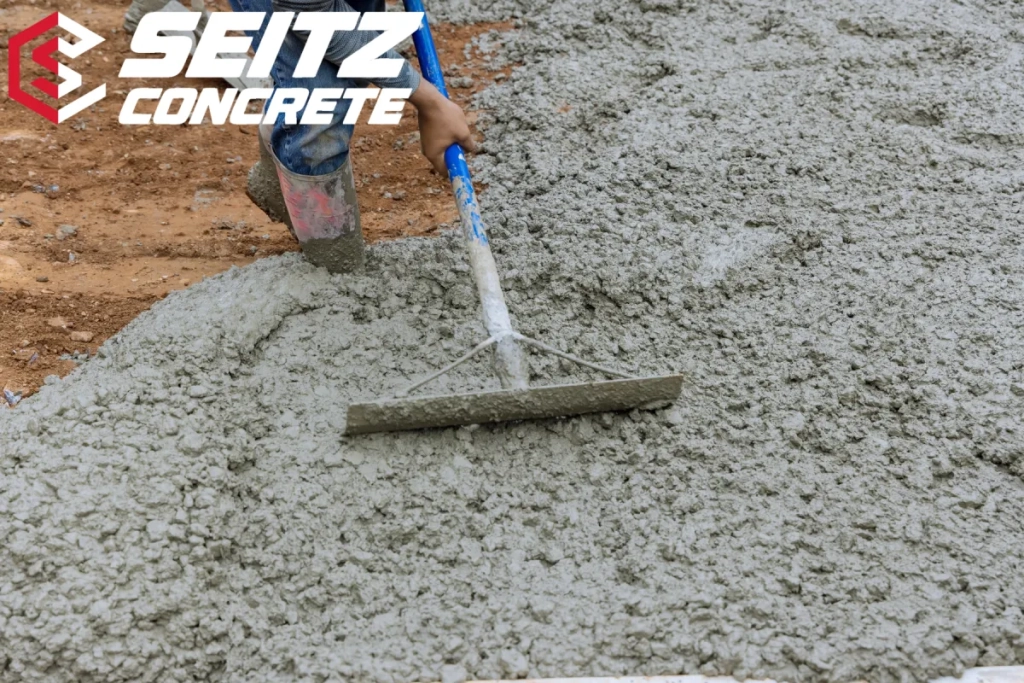
A high-strength concrete mix (minimum 4,000 PSI) is poured and spread evenly. Vibrating tools remove internal air pockets around the rebar, ensuring maximum compressive density across the entire footprint.
4. Cutting Strategic Stress Control Joints: Creating Controlled Relief Lines.
Control joints are saw-cut to a depth equal to 1/4 of the slab’s total thickness within 12 to 24 hours of pouring. These joints relieve internal tension, forcing contraction micro-cracks to form invisibly along straight cut lines.
5. Controlled Curing and Protective Sealing: Locking In Hydration and Moisture Defense.
A moisture-retaining cure compound is applied immediately after finishing to allow full hydration over seven days. Once cured, penetrating sealers are applied to block water absorption and surface scaling.
Applying Our [Seitz Concrete System] to Solve This
At Seitz Concrete, we do not view flatwork as a quick commodity job. Guided by strength, trust, precision, and professionalism, we comply with strict ACI Standards on every project. Our structured process ensures clean execution, direct communication, and a finished product backed by on-site project management and tiered 1-, 5-, and 10-year warranty options.
Here is how our proprietary [Seitz Concrete System] works to protect your home:
- Precision Concrete Demolition & Site Prep: Every job starts with professional excavation to remove unstable dirt, old paving, and organic material before setting a compacted aggregate sub-base.
- Integrated Drainage & Curb Solutions: Proper elevation grading and Integrated Drainage & Curb Solutions direct rainwater away from garage doors and foundation walls, eliminating pooled water that weakens subgrade soil.
- Engineered Surface Finishes: Depending on your design goals, we offer specialized surface options, including Decorative Stamped & Patterned Driveways, Exposed Aggregate Finishes, and classic Brushed & Non-Slip Surfaces engineered for traction and durability.
- High-Grade Penetrating Sealers: We apply high-grade penetrating sealers that bond deep within the concrete pores, creating a hydrophobic shield against moisture penetration, chemical spills, and surface flaking.
- Dedicated On-Site Project Management: A dedicated project manager oversees every pour, verifying rebar depth, slump consistency, and cut-joint spacing so your project stays organized and stress-free.
- Proven Local Work: While working on a project for a property owner in Edmond, our project manager noticed soft, moisture-heavy clay beneath the existing driveway. We excavated three inches of soft material, installed geotextile fabric, and compacted a reinforced stone base to guarantee long-term stability under vehicle traffic.
Debunking the Myth: “Adding Extra Water on the Job Site Makes Concrete Stronger”
A common industry myth is that adding extra water to the mixer truck helps concrete flow smoothly and cures stronger.
Here is why adding excess water damages your driveway:
- Extra Water Lowers Compressive Strength (PSI): Concrete hardens through a chemical reaction called hydration, which requires a specific water-to-cement ratio. Adding excess water creates micro-cavities in the slab, reducing 4,000 PSI concrete to 2,500 PSI or lower.
- Water Rises to Cause Surface Flaking: Excess water bleeds to the top surface during finishing, bringing fine sand particles with it. This creates a weak, powdery top layer that flakes, scales, and dusts after its first freeze cycle.
- High Slump Causes Extreme Shrinkage: A watery, high-slump mix shrinks significantly as it dries, creating internal stress that results in widespread spiderweb cracking before vehicles ever drive on it.
Technical Specifications & Concrete Glossary
Understanding key construction terms helps you evaluate proposals and choose the right contractor for your property:
ACI Standards (American Concrete Institute)
The national engineering guidelines that govern concrete mix design, steel reinforcement placement, curing times, and load-bearing capacities for structural integrity.
Control Joint (Contraction Joint)
A pre-cut groove placed at specific intervals in a concrete slab that creates an intentional weak plane, directing expansion stress along a straight, hidden line.
Concrete Slump
A test measuring the consistency and wetness of fresh concrete before it is poured. A lower slump indicates a denser, stronger mix with less excess water.
Subgrade & Aggregate Base
The prepared soil layer and compacted stone foundation beneath the slab that distributes vehicle weight evenly across the ground.
People Also Ask (FAQ)
Is it normal for a new concrete driveway to have small hairline cracks?
Minor surface hairline cracks can appear as moisture evaporates during curing. However, wide, uneven, or deep structural cracks indicate poor subgrade compaction, skipped rebar reinforcement, or improper joint placement during installation.
How thick should a residential concrete driveway be poured?
Standard residential driveways require a minimum thickness of 4 inches poured over a 4-to-6-inch compacted stone aggregate base. For properties supporting heavy utility trucks, boat trailers, or large RVs, a 5-to-6-inch slab with an elevated steel rebar grid is recommended.
How long after pouring can I park my car on a new concrete driveway?
Foot traffic is safe after 24 to 48 hours. However, vehicles should stay off the new surface for at least 7 days. Concrete reaches approximately 70% of its full structural strength at 7 days and reaches design strength at 28 days.
Why should I hire a contractor that follows ACI Standards for concrete driveways?
Following official guidelines ensures correct sub-base compaction, proper rebar elevation, accurate joint placement, and controlled curing. This precise approach prevents premature cracking, surface scaling, and costly slab replacements caused by local soil movement.
Build a Solid Driveway That Lasts
An Edmond concrete driveway should deliver clean aesthetics, structural strength, and reliable performance year after year. While weather shifts and ground movement put stress on any outdoor slab, severe structural cracking is completely preventable with proper site prep, rebar reinforcement, and expert finishing.
At Seitz Concrete, we bring a bold, straightforward, and professional standard to every project. We handle residential driveways, patios, pool decks, walkways, and commercial flatwork with clean execution, organized communication, and long-term quality. When you partner with our team, you receive a premium experience backed by ACI compliance, on-site project management, and reliable warranty options.
If you need specialized flatwork installation or durable concrete driveways in Edmond, our team is ready to deliver.
Ready to invest in a driveway built on strength and precision? Contact us today to request a consultation and get a comprehensive quote for your property!